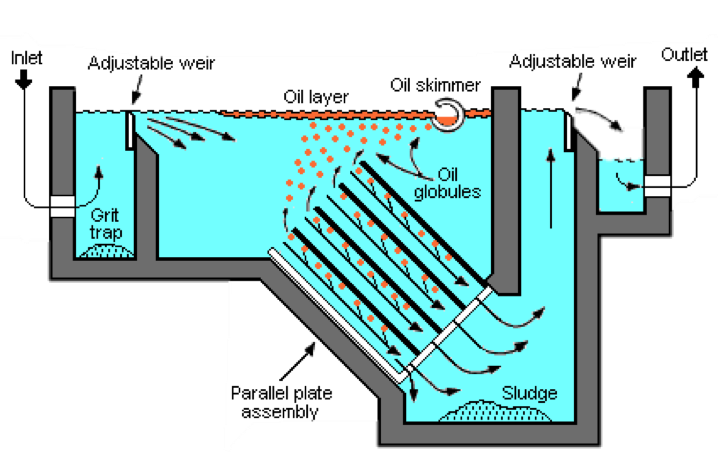
Plate degreasers (APIs), which are designed according to the standards of the American Petroleum Institute, are among the most widely used fat, oil, and grease (FOG) separation systems from industrial and municipal wastewater. These systems significantly increase the separation efficiency by using inclined plates and are a suitable alternative to traditional tank degreasers.
Design Principles of Plate Degreasers (API)
Main Structure
-
Main chamber: Usually of concrete, rusty steel or heavy polyethylene
-
Sloped plates: at an angle of 45° to 60° relative to the horizon
-
Input system: With convenient design for uniform flow distribution
-
Fat Collection Chamber: On the Upper Part
-
Sedimentation Chamber: In the Inback
-
Refined Wastewater Output
Separation Mechanism
-
Physical principles:
-
Density difference between water (1000 kg/m³) and fat (≈900 kg/m³)
-
Stokes’ Law for Flotation of Lipid Particles
-
-
Role of Sloped Plates:
-
Increasing the effective level of separation
-
Reducing the climbing distance of fat particles
-
Creating a calm and layered flow
-
 Technical Calculations of THE DESIGN OF THE IP
Key parameters
-
Vertical crossing speed (Vc): Usually 0.75-1.25 m/h
-
Hydraulic Retention Time (HRT): 30-60 minutes
-
Special level of pages (A):
A = Q / (Vc × cosθ)
Where:
-
Q: Sewage dubai (mı/h)
-
θ: Angle of plates with horizon
-
-
Count pages (N):
N = A / (L × W)
-
L: Page length (m)
-
W: Width of pages (m)
-
Computational Example
For sewage with a flow rate of 10 m³/h and 1.5×0.8 m slabs at a 45° angle:
A = 10 / (1 × cos45°) = 14.14 m²
N = 14.14 / (1.5×0.8) ≈ 12
Benefits of API Plate Degreasers
-
High efficiency: separation of up to 95% floating fats
-
Low space requirement: 50% reduction in space compared to tank types
-
Low operating cost: no need for electrical energy
-
Easy maintenance: Simple mechanical system
-
Flexibility: Adaptability to Different Flows
-
Long lifespan: more than 15 years with good maintenance
Disadvantages and limitations
-
Variable Flow Sensitivity: Reduced Efficiency in Irregular Flow Rate
-
Limitations in the separation of emulsions: the need for chemical pretreatment
-
Sediment accumulation: Periodic washing of plates
-
Relatively high initial cost: especially in stainless steel models
Industrial Applications
Food Industry
-
Slaughterhouses and meat processing
-
Dairy Factories
-
Industrial Restaurants
-
Production of vegetable oil
Petroleum & Petrochemical Industries
-
Refineries
-
Oil terminals
-
Auto Repair Shops
Other Industries
-
Metal & Machinery Industries
-
Detergent Factories
-
Large business centers
Comparison with other types of degreaser
| Feature | API Plate | Simple Tank | DAF | Biological |
|---|---|---|---|---|
| Randman | 90-95% | 60-70% | 95-99% | 85-90% |
| Space Requirements | medium | a lot | less | a lot |
| Investment Cost | medium | less | High | High |
| Operating Cost | less | less | High | medium |
| Sensitivity to emulsions | medium | High | less | less |
Design and Manufacturing Standards
-
IP 421 Standard: Design Technical Requirements
-
EN 1825: European Standard
-
ASME A112.14.3: American Standard
-
Iranian National Standard 10254: Executive Requirements
Maintenance and operation
Repair Programs
-
Daily cleansing: Collect floating fats
-
Weekly Washing: Cleaning Plates
-
Monthly inspection: Monitor the condition of plates and gaskets
-
Annual Repairs: Complete Structural Inspection
Key points of exploitation
-
Regular input pH control (Optimal 6.5-8.5)
-
Preventing the entry of coarse solids
-
Sewage temperature monitoring (optimal 40-20°C)
-
Regular registration of operational parameters
Recent Innovations in API Design
-
Corrugated Plates: 20% increase in separation efficiency
-
Nanocoatings: Reducing Fat Adhesion
-
Automated Cleaning Systems: Reduced Manpower
-
Online Monitoring: Continuous Measurement of Fat Concentration
Conclusion
Combining simplicity of operation and high efficiency, API plate degreasers are an ideal choice for many industries. These systems are able to separate fats effectively without the need for a lot of energy by using basic physical principles. Choosing the right dimensions and designing the right ones based on the characteristics of the wastewater is the key to achieving the best performance.
Technical Recommendation: For large projects, it is essential to conduct pilot studies before final implementation and consult with experienced wastewater treatment engineers. Also, the use of quality materials in the construction of plates and bodies, especially in corrosive environments, can lead to a significant increase in the lifespan of the machine.